
“I don’t like violence, Tom. I’m a businessman.” – The Godfather

People say violence is never an option, but when I’m in a room with a Kardashian, well, let’s just say it’s option number one.
- Those who have an opposing ideology are considered evil.
- People actively avoid being near those of opposing ideology. Might move from communities or states just because of ideology.
- Common violence. Organized violence is occurring monthly.
- Common violence that is generally deemed by governmental authorities as justified based on ideology.
- Opposing sides develop governing/war structures. Just in case.
- Open War.
Volume V, Issue 6
All memes except for the clock and graphs are “as found”.
This is a moving situation, and things are changing quickly. The advice remains. Avoid crowds. Get out of cities. Now. A year too soon is better than one day too late.
In this issue: Front Matter – New Achievement Unlocked: Acceptable Violence – Violence and Censorship Update – Biden’s Misery Index – Updated Civil War 2.0 Index – Are We At War? Revisited – Links
Front Matter
Welcome to the latest issue of the Civil War II Weather Report. These posts are different than the other posts at Wilder Wealthy and Wise and consist of smaller segments covering multiple topics around the single focus of Civil War 2.0, on the first or second Monday of every month. I’ve created a page (LINK) for links to all of the past issues. Also, subscribe because you’ll join nearly 820 other people and get every single Wilder post delivered to your inbox, M-W-F at 7:30AM Eastern, free of charge.
New Achievement Unlocked: Violence Acceptable
One of the hallmarks of the countdown to Civil War 2.0 has always been: Common violence that is generally deemed by governmental authorities as justified based on ideology. We’ve debated about where to put it, but it’s been there since the very start of the countdown/index. This month a Constant Reader sent me a link to American Partisan where the article discussed exactly that (LINK).

When a high government official formerly in charge of extrajudicial executions calls for the extrajudicial execution of an elected official to a national body, you might live in a banana republic.
- 31% of Trump supporters and 24% of Biden supporters indicated that democracy is no longer viable.
- 41% of Biden supporters and 38% of Trump supporters thought it was acceptable to use violence to stop their opponents.
Yes, I know that technically we’re not a democracy anyway because the Founding Fathers felt that was little more than mob rule, but it looks like a huge chunk of people are flat done with the idea of voting with ballots and are ready to start voting with fists, clubs, and bullets.

Except against women. Or people who identify as women. Or Leftists. But I repeat myself.
This, sadly, is something that many have expected as the government loses the legitimacy that it enjoyed during most of the history of the country, with only 16% (according to Pew®) trusting the government to do way is right most of the time.
As I’ve mentioned before, some of the best advice I’ve ever heard about divorce was, “If you don’t want a divorce, don’t talk about one.” Here, large numbers of the population are currently contemplating divorce, and contemplating not using a lawyer to get what they want, since 41% of Trump supporters and 30% of Biden supporters are in favor of secession based on political lines.

Although there is a flaw in the Leftist strategy.
Even when I started this blog, that seemed unlikely. Although the maps show Red states and Blue states, the reality is that in 2016, many of them were purple – a roughly equal mixture of both.
Now we see that people really are moving from one state to another for purely political reasons. If you’re on the Right, why live in a state that will criminalize you because you own guns? If you’re on the Left, why live in a state that won’t let you kill all the babies you want to kill?

Violence and Censorship Update
Hillary Clinton, that bastion of common sense and moderation, noted this month that people who supported Donald Trump need to be “formally deprogrammed”. If you think the Left is up for a truce and to forgive, that would be a mistake.

Proving that a Leftist is as loyal as a scorpion, well, read the note below.

But, good news for her! She can update her Tinder® profile.

In a further example that we are at an 8. on the steps to Civil War 2.0 (list above, more story below) Portland has stopped trying to look good for a date, and is now at the stage that they’re eating frosting straight from the plastic container with a spoon. The cops have given up.

The EU wants Elon Musk to censor comments on X®. The only problem? Like taking a woman to a restaurant, the want Elon to figure what they want him to censor without telling him.

Regardless of how you feel about, well, anyone, the First Amendment exists. Except for certain subjects as the former governor of Mumbai points out below:

And Ron’s not far behind:

Lastly, Canadians seem to enjoy a few freedoms. At least today:

Biden’s Misery Index
Let’s take a look to see how we’ve done this month . . . .

Yup, up again. Looks like Biden is going for the record. Who says he never gets anything done? I hear he was even on hand to thank one of his financial supporters.

Updated Civil War II Index
The Civil War II graphs are an attempt to measure four factors that might make Civil War II more likely, in real time. They are broken up into Violence, Political Instability, Economic Outlook, and Illegal Alien Crossings. As each of these is difficult to measure, I’ve created for three of the four metrics some leading indicators that combine to become the index. On illegal aliens, I’m just using government figures.
Violence:

Violence is up again, again slightly – I was expecting more during a long, hot summer. I’m guessing that people don’t even notice it anymore. Think San Fran will be paying for cops anytime soon?

Political Instability:

Up is more unstable, up. I expect December to be a time when this starts to head upward, significantly, because, bears.

Economic:

Economic numbers are swinging back down again this month, and a bit more in October – I expected more. Well, we’ll see. Maybe there will be a miracle?

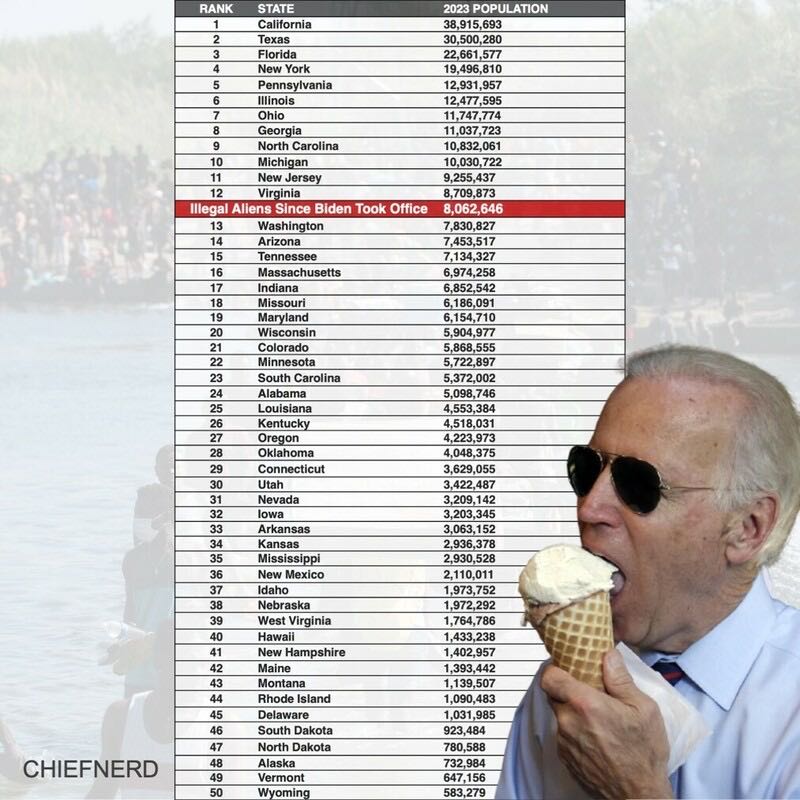
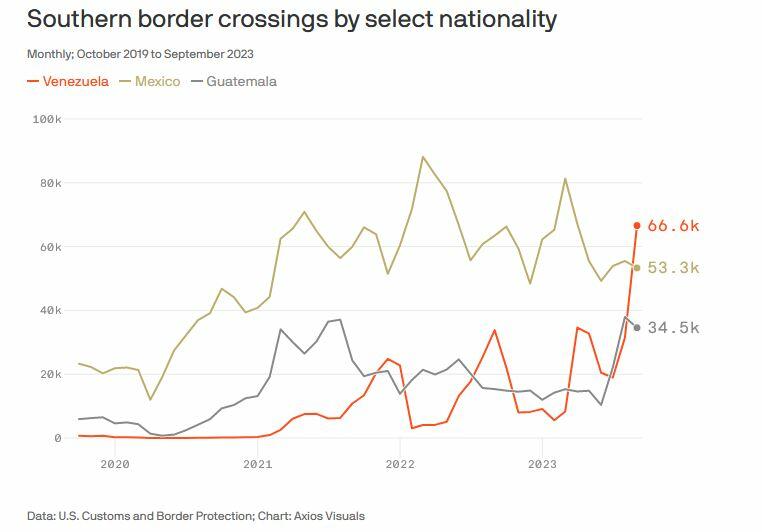
Illegal Aliens:

The biggest number, ever, in the history of the country, an unending flood. Read Enoch Powell’s speech.

Are We At War? Revisited
Last month’s Weather Report topic was a simple question: Are we at war? The reason for this is that a Constant Reader said I was obviously stoned, because the war was obviously already going.

Another Constant Reader responded to this response as noted above that I was stoned for thinking we were closer to war than they did, and I thought it was a more than fair assertion that deserved a response: “Not 8. Not anywhere close to that.”
Well, as to point 6., where people are avoiding the other side, this is an ongoing process I noted that began years ago. I have several friends that have specifically decided to move away from Leftist hotbeds for exactly that reason. My own brother, John Wilder, is currently behind enemy lines in the Reddest area of a very blue state. He’ll be moving before too long to a very, very Red State where he is no longer considered to be an extremist.

He does, however, have a great lawn.
Next, to point 7. If anyone doesn’t think that organized violence is occurring regularly, they need to revisit their news sources. Cities, even in Red States, are being run not by cops, not by commissions, and not by mayors. Those cities are being run by district attorneys that are not prosecuting criminals and are sanctioning the violence. It’s bad enough that it’s normalized – the group protests, riots, and mob thefts that are occurring with the tacit approval of the “justice” system takes us to an 8. Reminder, this Civil War won’t have masses of armed troops to inflict the damage, especially at the start.
To get from 8. to 10. could happen in as little as two weeks – imagine another blatantly stolen election in 2024 . . . that might be the spark. As shown in the first story, polls indicate that a growing number of people no longer want peace at all costs, and the peace that flows from the barrel of a gun would be quite acceptable.

It’s odd when the Muppet® doesn’t have the silliest hair.
Are we at an 8.? I think so. It doesn’t get to a 10. until the Right starts to fight back. I do appreciate the feedback, since this is a work in progress, and it also nudges me to explain what the heck my reasoning is. YMMV.
The fact that two readers with valid points make the opposite argument makes me think I’m close to the right answer. We are very, very near.
LINKS

As usual, links this month are courtesy of Ricky. Thanks so much, Ricky!!
BAD GUYS
https://twitter.com/i/status/1718365747414761547
https://twitter.com/i/status/1720452778508595253
https://twitter.com/i/status/1718594209450480043
https://twitter.com/i/status/1719551215858798957
https://twitter.com/i/status/1715239983911452861
https://twitter.com/i/status/1715236903853691077
https://twitter.com/i/status/1714199598871228535
GOOD GUY?
https://twitter.com/i/status/1716945256804200575
ONE GUY
https://twitter.com/UR_Ninja/status/1716227124275626374
BODY COUNT
https://citizenfreepress.com/wp-content/uploads/2023/10/biden-state-illegals.jpg
https://www.thecentersquare.com/national/article_9d841124-7449-11ee-af4a-af115ad29337.html
https://twitter.com/i/status/1707919466154082771
https://twitter.com/Jeanne2999432/status/1719039832633041054?t=Nd5Phexy5Xh6W1OcG6-yIw&s=19
https://cms.zerohedge.com/s3/files/inline-images/axis.JPG?itok=tZ4zVVGS
https://www.dailymail.co.uk/news/texas/article-12663663/Venezuelas-worst-gangsters-criminals-cross-border-carrying-orders-dictator-Maduro.html
https://www.dailymail.co.uk/news/article-12699675/US-border-China-migrants-caravan.html
https://www.dailymail.co.uk/news/article-12666301/Migrants-NYC-costing-taxpayer-5BN.html
https://www.dailymail.co.uk/health/article-12484069/US-deaths-mortality-richest-countries.html
https://tnc.news/2023/10/26/assisted-suicide-in-canada-2022-1/
VOTE COUNT
https://citizenfreepress.com/wp-content/uploads/2023/10/emerald-fraud.jpeg
http://onlyinbridgeport.com/wordpress/watch-video-captures-gomes-supporters-absentee-ballot-dumping/
https://thefederalist.com/2023/10/05/10-ways-democrats-are-already-rigging-the-2024-election/
https://www.emerald.tv/p/georgias-election-officials-are-getting
https://thefga.org/research/ranked-choice-voting-partisan-plot-to-disrupt-elections/
CIVIL WAR
https://www.newsweek.com/democrat-civil-war-reaching-boiling-point-1840367
https://news.yahoo.com/large-portion-americans-doubt-democracy-160659069.html
https://www.zerohedge.com/news/2023-10-12/civil-war-5-4-3-2
https://www.governing.com/context/what-would-a-national-divorce-look-like