2025 In Review: The Wilder Way

“You’re up for review.” – Fight Club

I wrote a review of why graphs should use wider lines.  It’s called, “The Plot Thickens”.

As an annual feature of Wilder, Wealthy and Wise, we poll our writers and editors and ask them to nominate the top stories of the year.  Since they are just me, it’s a far less complex process than you might imagine.  Here are the top stories of 2025:

January 2025

  1. Donald Trump is inaugurated as the 47th U.S. President.  Trump immediately issues executive orders on immigration, trade, and withdrawing from international agreements like the Paris Accord.  Alexandria Occasional-Cortex protests, “I didn’t even know the French could pronounce ‘Honda®’, I mean, wouldn’t it sound like ‘Onda?  So we should let them have an Accord®.  It’s a sensible car.”
  2. Wildfires ravage Greater Los Angeles, destroying over 13,000 structures, prompting evacuations and a state of emergency.  Governor Gavin “Reptile Smile” Newsom declares homeowners may rebuild that the land will be confiscated and given to people that buy him nice things.
  3. Bulgaria and Romania join the Schengen Area, lifting land border controls in Europe.  Bulgaria is still awaiting its first visitor and has the crepe paper decorations and everything along with party poppers and a 10% discount coupon to Bob’s Bulgarian Borscht, Baguette and Baklava Buffet®.
  4. Liechtenstein legalizes same-sex marriage, becoming the 37th country to do so, and demands to be known as Gay Liechtenstein.

February 2025

  1. Trump imposes 25% tariffs on imports from Canada and Mexico, and 10% on China, sparking retaliatory measures and trade tensions.  Trump then immediately lowers them, noting, “I shot the tariff, but I did not shoot the subsidy.”
  2. China retaliates with export controls and tariffs on U.S. imports amid escalating trade war, threatening to send more TEMU® products and advertisements if the U.S. does not relent.
  3. Canada wins the 2025 4 Nations Face-Off hockey tournament against the U.S.  Nic Cage and John Travolta are unavailable for comment.
  4. The Taliban visit Japan for first diplomatic engagement since 2021 as the Japanese noted they were no longer talibanned.

March 2025

  1. Trump pauses U.S. military aid to Ukraine after tensions with Zelensky when Zelensky wouldn’t eat his peas at dinner.
  2. Romanian protests erupt against election annulment, supporting the far-right one candidate who doesn’t Romanians replaced by Syrians.
  3. The Nagoya High Court in Japan rules non-recognition of same-sex marriage unconstitutional, primarily because of military pressure from Gay Liechtenstein.
  4. Trump increases tariffs on Chinese imports to 20%.  Or 60%.  Or 200%.  Can’t keep track.
  5. India launches missiles into Pakistan after a terrorist attack, escalating border tensions over regional fights against body hygiene, deodorant requirements, and who had first scamming rights over Oregon.

April 2025

  1. Trump imposes sweeping tariffs on imports from multiple countries, escalating global trade wars.  Or lowers them.  Or maybe doesn’t change anything at all.  I can’t remember.
  2. Pope Francis dies at 88 after mentioning he had inside information about Clinton crimes.
  3. China increases tariffs on U.S. exports to 84% in retaliation.  Or lowers them.
  4. South Korean President Win Won Soon impeached and removed and sent to Alabama to coach football.

May 2025

  1. Robert Prevost elected as Pope Leo XIV in the papal conclave, narrowly edging out Grammy®-nominated artist Taylor Swift.
  2. Germany’s AfD designated as extremist because it objects complete replacement of Germans by 2032, instead demanding it be put back to at least 2040.
  3. Japan allows bears in urban areas to be shot by hunters, as long as the bears are not gay, though the hunters can be gay and are encouraged to be vegan.

June 2025

  1. Protests erupt in Los Angeles over ICE deportations, leading to clashes and National Guard deployment and threats of military intervention from the Grand Gay Dutchy of Gay Liechtenstein.
  2. The U.S. intervenes in the Israel-Iran conflict by bombing Iranian nuclear facilities, which is less an intervention and more of a bombing.
  3. No Kings protests occur across U.S., Canada, Europe, Japan, and Mexico against Stephen King, Larry King, King’s Hawaiian Rolls® and King Kong™.
  4. An Air India© flight crashes in Ahmedabad, killing 242, proving that Indians can manage to kill more Indians than Pakistan can.  Prime Minister Modi proclaims:  “India Global Superpower 2030!”

July 2025

  1. Republicans pass sweeping tax changes through reconciliation in U.S. Congress.  No one is sure what is in them but the lobbyists say that it’ll be great.
  2. The International Court of Justice® (Superman presiding) rules countries can sue over historical greenhouse gas emissions.  White Americans immediately sue the descendants of black slaves for greenhouse reparations, noting that if they really were the ones who built America, it’s time for them to pay up.

August 2025

  1. OpenAI® releases GPT-5™.  Sam Altman celebrates by sacrificing a small child, but the evil god he worships rejects it because, “It’s not really a sacrifice because he does it every Tuesday.”
  2. The Russia-U.S. summit at Joint Base Elmendorf in Anchorage focused on the Ukraine conflict, got nothing done, but did have a nice burger and a promise to meet up again “in a week or two, you know, I’ve got a lot of stuff going on”.
  3. Air Canada© flight attendants strike to ban requiring stewardesses to serve in-flight beverage service to Indians hanging on the wings.
  4. Anti-immigration rallies in Australia lead to clashes against the evil white people who are totally not being replaced by the hundreds of thousands of refugees brought in to replace them.

September 2025

  1. The French government collapses after no-confidence vote.  Again.
  2. The Grand Gay Dutchy of Gay Liechtenstein demands the return of their gay crown jewels from France.  France protests, noting, “We’re not exactly sure where Liechtenstein is.”

October 2025

  1. In the U.K., Sarah Mullally becomes the first female Archbishop of Canterbury and immediately offers apology for all Christians resistance to moslem grooming gangs, noting, “It’s really white privilege to expect to not be sexually violated by short swarthy men with no upper body strength.”
  2. Grand Duke Henri of Luxembourg abdicates as the Gay Grand Gay Dutchy of Gay Liechtenstein attacks and begins to consolidate a European Homohegemony.

Why did Bing® A.I.® put Manson in the picture?

November 2025

  1. Canada’s measles-free status revoked.  Which is weird, because they had been measles-free since 1998.  Wonder how that could have happened?  No reason at all, I guess.  Odd coincidence that some of the highest measles rates in the world are in India.
  2. The Saskatchewan Roughriders win the Grey Cup.  Whoever and wherever they are, and whatever that it.

December 2025

  1. Trump’s economic approval hits a new low at 36%, but that only fills him with strength, and he decided to annex Antarctica and name it New Greenland.
  2. Sanae Takaichi becomes Japan’s first female prime minister, and immediately begins plotting to re-take Manchuria after tidying up a bit and doing some dishes.
  3. The Gay Grand Gay Dutchy of Gay Liechtenstein cedes the Gay Presidency of Europe to The Trans Republic of Trans Transylvania.
  4. Thieves steal priceless jewelry from the Louvre in France, but after they’re caught and determined to be moslem, are then given a key so they can loot whenever they want.

What a year!

What did I miss?

Bubbles Within Bubbles Within Bubbles

“I had it all, even the glass dishes with tiny bubbles and imperfections.” – Fight Club

I wonder if Sean Connery is in 00 Heaven?

As we approach the end of 2025, the U.S. economy resembles a science-fair volcano built on baking soda, hype, construction paper, speculation, bubblegum, vinegar, and greed.  I’ve written about this before, and, well, it’s so big it keeps dragging me back in.

The rot is birthed by several mothers:   cheap cash, the need to put it somewhere, and a new technology whose benefits are (at this point) opaque at best.  Let’s put down that you already know “money printer goes brrrrrrrr” so we’ll go back to A.I.

Again.

At the center of this precarious structure is what everyone who isn’t high on their own supply knows is an A.I. bubble.  Large numbers of people (including me) recognized the housing bubble for what it was, but it kept on going because momentum is one hell of a master.

Another case of car-pole-tunnel syndrome.

A.I. has inflated stock prices, diverted resources like a drunk wine aunt at Lululemon®, and now has spawned secondary bubbles in hardware and infrastructure.

I’ve touched on this in previous posts, noting how projected AI:

  • growth outpaces any reasonably available power supplies, present and near future,
  • revenue projections fall short of the grandiose promises, and
  • the full realization of AI’s (theoretical) potential could unleash economic distortions on a scale we’ve rarely seen in human history.

But bubbles don’t exist in isolation.  Bubbles multiply, feeding off each other until the inevitable pop unwinds it all.  When the Great Housing Bubble burst, for example, sales of sulfuric acid went to zero for months.  How are they related?  Turns out the Great Housing Bubble was fed off the same credit structure that paid for basic chemicals.

And for all this time I thought it was because sulfuric acid was just like anything Chuck Schumer says:  baseless and corrosive.

One time in chemistry they asked me to write 1,000 words on acid.  I couldn’t finish it because my pen turned into a giraffe and the paper melted.

Today, we’re seeing this play out in real time, with AI-driven demand ripping into consumer electronics and beyond, all while broader market indicators flash warning signs of decline.

The AI stock bubble has birthed an investment bubble in virtually all computer hardware. Demand for specialized components has skyrocketed, pulling supply away from consumer markets and inflating prices across the board.

  • RAM prices surged 172% year-over-year, with some guessing they’ll double in 2026,
  • SSD prices per TB are climbing with AI and cloud providers tightening supply chains.
  • Motherboards shortages are emerging as manufacturers prioritize AI server builds over consumer PCs, with one producer having sold out for 2026 already.

This shift isn’t just raising costs for gamers and everyday users; it’s distorting global supply chains, creating a feedback loop where AI hype justifies more investment, which in turn inflates hardware bubbles.

The statistics say cows kill more people than sharks, but I’m surprised that cows are killing any sharks.

What happens when the tide rolls out?  With the underlying economy already showing recessionary cracks, the fallout will almost certainly be severe.

Let’s start with the AI bubble itself:   valuations in the sector have soared, with companies like Nvidia™ and others commanding trillions in market cap based largely on future promises rather than current realities.  The S&P 500’s concentration in a handful of AI-related stocks reached 30% by late 2025, the highest in decades. Nvidia© (for example) doubled in price from April.

Doubled.

Skepticism is now mounting.

All this is unfolding against a backdrop of broader economic weakness that A.I. papered over.

Oil prices are declining despite ongoing disruptions from wars in Ukraine and tensions with Iran.  Price levels are back into COVID 2021 levels.  This drop persists amid supply risks: Ukrainian drone strikes on Russian refineries and U.S. sanctions on Venezuelan tankers should theoretically support prices, yet oversupply fears dominate.

My dad once asked me, “Son, if you have a hot blonde rubbing oil on a hot brunette, what do you get?”  I answered, “I don’t know, Pop.”  “Your camera, son, your camera.” (as found)

If peace breaks out in Ukraine, bringing Russian oil fully back online, prices could plummet 30%-50% as sanctions lift and exports surge.  Add in a resolution with Iran, and the glut could be historic—you might as well use oil for bubble baths.  The IEA already forecasts surpluses building into 2026.

This is a signal of weakening industrial activity worldwide, not resilience.

Domestic indicators paint a similar picture. Unemployment among native-born Americans ticked up to 4.7% in July 2025 from 4.5% a year prior, with the overall rate holding at 4.6% in November.

Wages? They’re stagnant at best.

The K-shaped economy persists:  high-wage earners see modest gains, but lower-income workers face stagnation, widening inequality.

So, what portends when the A.I. Bubble bursts?

History offers grim lessons: the Dotcom crash wiped out trillions and triggered a recession and the economic response to that caused he Great Recession.  An A.I. pop could be worse, given its entanglement with hardware and infrastructure.  It doesn’t help that it is spawned, in part, by the loose-money policies of the post-COVID world.  If I’m making an SAT question, Dotcom is to The Great Recession as COVID is to ___________.

  1. The A.I. Bubble
  2. A giant PEZ® dispenser filled with plutonium pellets
  3. Greta Thunberg
  4. The Black Studies Department at Harvard®

He then arrested me for assault with sandpaper.  He didn’t accept the excuse that I’d only roughed the guy up a bit.

Consequences of it popping?

  • Investment in data centers and chips dry up, leading to layoffs of all those H-1Bs in San Fran and cratering the tech manufacturing here and in many nations around the world.
  • Deflation hits: hardware prices would crash as overcapacity floods the market, but not before bankrupting suppliers who bet big on eternal demand.
  • Dogs and cats, living together.
  • With the economy already teetering: slow job growth, wage pressures, and oil signaling demand weakness, the rest are downstream consequences.
  • Consumer spending, which has propped up GDP, falters as confidence erodes and debt defaults rise.
  • Income inequality worsens because banks and Wall Street firms cannot be allowed to fail.

If this capital misallocation is as bad as some of the graphs I’ve seen, this will be the singular economic event of the lifetime of anyone alive.  There is a reason that I picked 2032 as the central pivot point of when Civil War 2.0 would show up and it was the underlying financial mismanagement of the United States.  A.I.?  It’s not the gasoline in the room, it’s the spark.

It would have been something.

I made this and even though I replaced it with a more fitting meme up above, I figured you’d want to see it.

In the end, bubbles always burst because they’re built out of illusions and fed by poor allocations of capital.  The A.I. frenzy has masked underlying frailties that would have led to a very major recession during Biden’s term, but the bubble continued to get bigger.

As oil slides, jobs stall, and hardware hype peaks, the reckoning looms.  And that science-fair volcano?  I hope I don’t drop it on my foot.

I’ll Krakatoa.

The usual.  Not investment advice, do your own research, etc., etc..  I’m not a priest or an exorcist though I played one on TV.  If you read this and make meaningful decisions based on it you need to take a step back and reconsider your life.

Is Everything Fake?

“Happy premise number three:  even though I feel like I might ignite, I probably won’t.” – Bowfinger

My ex-wife was more versatile than carbon:  she could form more than four bonds at the same time.

The economy recently feels to me like a(nother) bad sequel to The Matrix:  smoke, mirrors, simulated steaks and guys pretending to be girls directing everything.

It made me think of Bowfinger, a 1999 Steve Martin flick.  Steve Martin plays the titular producer, Bobby Bowfinger.  His character drops this gem while trying to scam a crew into working on his latest film:

“That’s after gross net deduction profit percentage deferment ten percent of the nut. Cash? Every movie costs $2,184.”

The rest, it’s like Hollywood?  Fake sets, fake stars, fake everything.  Our economy, I think, has officially hit 8.9 out of 10 on the Bowfinger scale.

It’s a façade of trillions propped on fraud, fiat, and fairy dust.  The evidence is everywhere:  from federal slush funds laundering cash to “charities” that fund political hit squads, to Somali scams siphoning billions for terrorist toys, to the AI hype train where Nvidia’s® GPUs vanish into vaporware voids.  It makes me ask one question:

Have we peaked at “peak fake”?

Genghis Khan stayed in shape during conquests by making sure he hit his steppe goal each day.

Start with the government’s golden shower of “aid.”  In the last few months, we’ve watched as the public found out that billions flood from Uncle Sam’s coffers to “nonprofits” and foundations that, surprise, boomerang right back to commentators, politicians, and partisan ops that give the opinions to the Democratically-appointed judges to make sure that their cash lifeline is safe from scrutiny.  Sibling marriages are less incestuous.

Remember the post-election blitz Democratic blitz?  A Free Press® investigation uncovered a $27 billion rush-out-the-door bonanza, with $20B hitting eight leftist nonprofits faster than Kamala could say “unbourboned by what has been.”

It would be one thing if these were soup kitchens serving the starving, but these are slush funds for radical agendas, exploiting tax dollars to bankroll everything from election meddling to “community organizing” that looks suspiciously like astroturf Antifa® activism.  It’s like if United Way™ funded Trotsky but funded by the Czar.

Robespierre, Trotsky, and Pol Pot walk into a bar.  There were no survivors.

And USAID?  They shelled $44K to Politico™ for subscriptions chump change, but emblematic of how federal funds feather media nests.  Nonprofits are NGO scams, funneling billions to progressive power grabs, sometimes even recycling it from overseas.  Ukraine is the country that just keeps giving.  I mean, if you’re a Democratic politician.

House hearings exposed how these networks weaponize your taxes for ideological insurgency.  You’re paying for the people who keep bleating:  “muh democracy.”  This is Bowfinger budgeting: real costs hidden, profits pocketed by players who script the narrative.

Speaking of Minnesota Somalisota . . . (otherwise known as Mogadishu on the Mississippi), the relentless spotlight has turned from Indian invaders to Somalian swindlers.  The “Feeding Our Future” fraud, where Somali networks allegedly pilfered over $250M from child nutrition programs during COVID.  That’s bad enough, but state audits have found broader scams at over $1 billion in taxpayer theft, with funds funneled overseas to anti-American terrorists.

Terrorist training:  “C-4 yourself.”

I mean, not just anti-American Democrats, but actual “was given a dowry of AK-47s, goats, and C-4” dirka-dirka terrorists.

This isn’t petty theft:  this is peak fake philanthropy that rivals the Clinton Foundation.  “Charities” as cover for African clan cash grabs, shipping your dollars to fund foes abroad.  If you watch videos of interviews with these people, they have no connection philosophically to the United States, wish to live under sharia law, don’t speak English, and don’t have jobs, other than stealing.  I guess the only saving grace is that at least these “charities” didn’t pay for Chelsea Clinton’s wedding and the terrorists are fine with using standard NATO rounds.

The next fake?  I’ve mentioned it again and again, Nvidia®.

It’s not so much Nvidia™ as the hype around A.I.  Nvidia® seems to (mostly) be just selling computer chips.  Mostly.  Their stock has been exploding upward like a Somalian with a grenade, doubling since April, with a market capitalization flirting with $4 trillion.

Who is buying all those GPUs, and for what?  Is it kids playing Fortnite®?

Ed Zitron, tech industry writer, estimates Big Tech needs $2T in AI revenue by 2030 just to justify their A.I. spending binge, or it’s going to lead to a fall that will leave a mark.  We’re back to Wilder’s A.I. Paradox:  if A.I. is valuable enough to be worth the money that’s being invested in it, it will wreck the economy with a wave of unemployment.  If it’s not, it’ll wreck the economy because it failed.

Yay!  It’s almost like we don’t have a choice!

My quantum computer wasn’t working, so tech support told me to turn it on and off at the same time.

It’s a lot like the French having a military:  if they fight, they lose, and if they run, they lose.

Who is buying this stuff?  The usual suspects: OpenAI®, Microsoft™, Oracle©, Amazon™, and Google©.  As we’ve shown here before, this investment simply doesn’t have the infrastructure like electricity, PEZ®, or clean water production to support it even if they could build all that stuff.  It smells like tulips in the Dutch Republic back around 1637.

Me?  I think it’s entirely possible that we’re building a multi-trillion-dollar computer that might wreck our economy if it works.  And it might wreck the economy if it doesn’t.

So, is this peak fake?

We’ve got governments gifting billions to grifters on an endless cash spin-cycle.  We’ve got immigrants importing scams and exporting cash to jihadi Jamal in Jowhar.  Also, we have A.I. alchemists turning silicon into massive debts that might be decadal mistakes.

If it was just that, yeah, it might all work out.  But there’s this:  the economy is a house of cards built on counterfeit confidence:  $36 trillion in fiat debt, infinite inflation, and innovations that might wreck everything if they don’t become a robotic overlord.  Is it any wonder that the smallest pebble dropped onto this slope might cause a landslide?

How much dirt is in a six foot deep, three foot diameter hole?  None.  It’s a hole.

Fake fails eventually, but often lasts longer than almost anyone would believe during inertia.

Will we reset?  I think that’s almost certain.  When will we reset?

That I can’t tell.  As long as everyone agrees that the market is up, the market is up.  But Wendy’s™ is getting ready to close 5% of its restaurants because the business is so great.  I think the lower end of the income spectrum has thrown in the towel.

“A Dave’s Single™?  What, do I look like a Rockefeller?”

Going back to The Matrix:  “You know, I know this steak Dave’s Single® doesn’t exist.  I know that when I put it in my mouth, the Matrix is telling my brain that it is juicy and delicious.  After nine years, you know what I realize?  Ignorance is bliss.”

Ignorance, bliss?  What do those words even mean?  In other news, I’m in a great mood!

Disclaimer:  This isn’t investment advice, this is an Internet humor column.  You might want to try those little cartoons they had in Bazooka Joe® gum for better advice on timing and market direction than I could give you.  I don’t own any positions in any stock mentioned in this post, and I also do not own (much) real estate on the Moon, though I was sold a 1/10th share in some bridge in New York by an Albanian.

It Came From . . . 1997

“The only good bug is a dead bug.” – Starship Troopers

Grok™ is getting better – this was a first attempt, and normally it requires a lot of wrestling.

OT:  probably a Saturday song will drop tomorrow morning.  I’ve got three more in can and think that two of the three are the best so far.  I may even drop one on Sunday.  We’ll see.  Going forward I’m going to target dropping songs on Sunday, Tuesday, Thursday and Saturday.  As I’ve just started, there seem to be an endless spring of ideas that I’ve been hoarding up my whole life, and I’m enjoying making them come to life.  Oddly, I’m my new favorite artist.  Working on distribution, still on a steep learning curve.

Once again, were’ back.  The high of the 1980s is far in the rearview mirror.  Now we’re on the long slope down.  Still, there were some fun movies.  These aren’t necessarily the best movies of 1997, instead they’re the films I think really exemplify the year.  As always, they’re in no particular order.

Waiting for Guffman – This is an ensemble comedy where I think the plan was that you have a basic plot and you let the talented, goofy people making the movie fill in the details.  Silly?  Yes.  Life changing?  No.  One thing from this particular movie that I find very sad is that the opening scene shows the local cops planning on having sniper overwatch for a local harvest festival in a small Missouri town.  It was funny in 1997 because it was absurd.  In 2025 it’s not.  I guess that’s just the price we pay for ethic food.  I wonder why we didn’t import only the recipes?

Austin Powers:  International Man of Mystery – Mike Myers creates a parody of a James Bond® film.  The particular genius is that the plot is just strong enough to hold everything together and not get in the way of the comedy.  The box office was quadruple the cost, so that worked out okay for Mike.  Bonus points for lovingly parodying the details of the Bond™ films, such as naming a female character Allota Fagina.  Sadly, this caused the James Bond© producers to make the Bond® films less fun by hiring Daniel Craig.

Breakdown – There is nothing special about this movie other than it is a very competent thriller that couldn’t be made in the time of cell phones.  Kurt Russell is good, and J.T. Walsh is suitably evil.  Cinematic popcorn.

Men in BlackThe X-Files™ was pretty big during this time period, so Hollywood decided to make a big budget science fiction comedy based on a fringe UFO topic.  I was this many years old when I found out it was also based on a comic book. It made nearly $600 million 1997 bucks, which would have topped the box office for the year except for that pesky Titanic.

Contact – This was a decent movie, though not one where I look forward to seeing it again.  It was decent, not great.  Plot summary:  aliens send us Hitler pics and instructions on how to build a wormhole.

Air Force One – More cinematic popcorn, where president Han Solo tries to kill Count Dracula on an airplane.  Silly action fun.

Event Horizon – My favorite movie on this list.  Huge critical and commercial failure and yet they nearly made a TV series based on it before COVID came along.  Evil Scientist Sam Neill?  Yes, please.  If you like cosmic horror and haven’t seen it, you’ve been missing out.  Warning:  it’s not for the faint-hearted.

Kull the Conqueror – Robert E. Howard was the creator of Conan the Barbarian, and also Kull.  This is based around his work, and was originally intended to be the third part of the Conan movie trilogy, but that fell apart.  I’m glad.  This movie is comfy and is its own thing.  I loved it, and am perhaps the only one, since it only made $6 million on a $35 million budget.  I guess I would suck as a test audience member.

L.A. Confidential – It came out in 1997, but I hadn’t seen it until recently.  It’s a decent film noir, and Guy Pearce does a great job as a smart, young cop eager to get ahead.  Huge hit, but I avoided it because I loathe Kim Basinger, who strikes me as a person with the intelligence of a basset hound.

Wishmaster – So an evil genie lives in a ruby.  In one scene, the camera penetrates they gem, showing that it contains a vast cavern throne room inside the gem.  In the cavern, it moves towards a dark, demonic figure sitting on the throne.  During the scene, when the camera finally centered on the genie’s face, I said, “Just sitting ‘round, being evil,” and The Mrs. laughed uncontrollably.  That’s now a family catchphrase.  Other than that, I don’t remember anything about this movie.

Boogie Nights – This is a very good movie, showing how the depravity, drugs, and money of the porn world lead only to pain and dejection, but I’m sure OnlyFans® will turn out differently.  Plus?  Stark nekkid Heather Graham.  Okay, I have contradictory motivations here.  Also, one of Burt Reynolds’ best serious roles.

RocketMan – Cost $16 million to make, made $15.4 million.  It was hilarious.  The underappreciated Harland Williams plays an accidental astronaut whose space hijinks include space farts.  It’s stupid-funny, so if you like adolescent humor, this is your show.

Bean – Rowan Atkinson is an engineer with a master’s degree and also a master of comedy.  Who says engineers don’t have a sense of humor?  Oh, and this film made $250,000,000.

The Devil’s Advocate – Soooooo much overacting in this horror movie which could have also been titled “Al Pacino’s Vocal Coach Is Seventeen Packs of Cigarettes a Day.”  No real desire to watch this one again – it’s not a great horror movie, but everyone liked it, because the boxoffice of $153,000,000 was nearly triple the cost.

Gattaca – This movie is about the dangers of genetic engineering on the future, where it creates a society where beautiful, healthy people are everywhere and bad genes are bred out.  The horror!

Starship Troopers – Whenever this movie comes up in the comment section everyone argues about it.  Every time.  Was director Paul Verhoeven trying to make Robert Heinlein look like a fascist and make the humans as the bad guys?  Yes.  Did almost everyone miss that?  Also yes.  To try to make fun of Heinlein, he had to actually quote Heinlein, which backfired in a big way.  Heinlein’s ideas in the book Starship Troopers are pretty powerful, but also simple.  They glimmered through Verhoeven’s attempt to make a woke film, which counts for most of the good parts of the film.  But the other fascist elements he added for the parody boomeranged on him to such an extent that all of the GloboLeft critics he wanted to please by making fun of the TradRight thought Verhoeven was a fascist.  I guess he sure showed the TradRight by being pro-human rather than loving bugs.  My verdict?  The only good things (which are very good) are the parts from the book.  The rest is mediocre at best.

Once again, I was surprised on how many movies I liked from this year.  Almost every movie is beautiful, but the attempts are being made to push the GloboLeft agenda even further, which is (along with foreign markets) what eventually choked Hollywood.  I’m debating if we’ll do 1998, and if so, that’ll be in February.

What did I miss?

The Simpsons, Radioactive Potato Salad, And Running Out Of Electricity

“I have become death, destroyer of worlds.” – Andromeda

Had Oppenheimer been a theoretical physicist he would have been frictionless, perfectly spherical, homogeneous, isotropic, involuntarily celibate, and have extended to infinity in all directions.  I guess one out of seven isn’t bad.

You know, Oppenheimer probably didn’t realize that his little gadget would one day power cat videos on YouTube®. But yet, here we are, preparing to stare down the barrel of an energy crisis that makes the 1970s oil embargo look like a minor hiccup at the gas pump.

America’s tech overlords are building A.I. data centers faster than a caffeinated beaver on gas station Chinese boner pills.  These behemoths suck down electricity like it’s free beer at an open bar to toss electrons so we can make A.I. cat videos because there weren’t enough cats in real life.

The scale is enormous:  gigawatts upon gigawatts, enough to finally get Marty all the way back to 1985.  But that begs this question:

Where’s all that juice coming from?

My walkie-talkie once took a lump of coal to a movie.  It was a classic example of radio-carbon dating.

Coal?  Ha!  That’s so 19th century, and the eco-warriors have pretty much chained themselves to the last coal plant, screaming about carbon footprints.

Natural gas?  Did everyone forget demand peaks in winter when everyone is cranking up the heat and prices spike like Nvidia® stock?  Are we going to have to keep our homes at 40°F (3.14 millipedes) just so ChatGPT® can make GloboLeftist women on the East Coast even more neurotic?

We need power, so, naturally, the bright sparks in Silicon Valley and D.C. turn to the holy grail: The Simpsons.

Sure, Homer® looks incompetent, but he hasn’t melted Springfield down.  Yet.  When The Simpsons started, they were mocking nuclear power in the typical GloboLeft drive to get it shut down.

Deep down, though, nuclear really always has been the only viable transition plan into the future.  Oil really will run out at some point, abiotic or not.

I had an allergic reaction and the doctor asked how I was.  “Swell.”

But nuclear?  If done right, it really can be clean, reliable, and if we don’t let Soviets do it, pretty safe.

So, problem solved.

Not.

We’re facing an immediate energy cliff.  In 2025, nuclear isn’t a parachute, it’s really more like a bedsheet and some twine.

With a little help from Constant Reader Ricky, who sent me an email.

I’ll quote him directly because, well, he nails it better than I could.

Ricky writes: “Existing commercial power reactors in the US have two key characteristics – their uranium is enriched from the natural 0.7% U-235 assay to a level of 3%, and they are cooled with pressurized water as the heat transfer fluid to run the turbines. The reactors were INITIALLY fueled via uranium enrichment done long ago in . . .  monstrous factories that are now closed.  An effectively experimental centrifuge enrichment operation in Piketon, Ohio shut down in 2016 without ever producing a pound of reactor fuel (we bombed a similar setup recently in Iran).

“Believe it or not, the US CURRENTLY fuels its commercial nuclear power reactors for the past ten years with Russian 3% enriched uranium, even through the Ukrainian war.  The Russians basically dilute some of their bomb grade 93% enriched uranium stockpile down into 3% reactor fuel as an export profit center.”

Key point courtesy of Ricky: “The current American commercial nuclear power program is 100% dependent on the Russians and has been for the last decade.”  He adds, “But we want that because that every kilogram of Russian uranium that goes IN a New York City power reactor is one less kilogram of Russian uranium that can go into an incoming nuclear bomb OVER New York City.”

He’s right.  I want the Russians to hit the Somilsotans first.  And then New York City twice.  It’s the only way to be sure.

And just like uranium, Hillary is unstable, hard to find, and expensive.  If only we could power a reactor with her tears.

It’s like we’re in a bad spy novel, relying on our geopolitical rivals for the fuel that keeps our lights on.  We can stamp our feet as much as we want to, but as long as Mom and Dad are paying the power bills, they call the shots.

With AI data centers projected to gobble up an extra 200-300 gigawatts by 2050 (that’s tripling our nuclear capacity), we’re supposed to ramp up nuclear like it’s no big deal.  It’s like the steady high school girlfriend you’ve been dating off and on for a year who you can always call for a date at the last minute.

Nope.

Building that kind of capacity?

Recent estimates peg adding just 63 GW at $354 billion.  We’re talking trillions when you factor in overruns. The Vogtle plant in Georgia – two reactors, “just” 2.2 GW, clocked in at $35 billion after fifteen years of delays.

Nuclear power makes NASA look prompt and frugal.

Okay, we’ll just do micro-reactors.

Except these micro wonders ditch the “obsolete” 3% enriched uranium for something hotter: 20% enriched stuff, packaged in pellets like, I don’t know, energy kibble. Supposedly, they’re meltdown-proof, corrosion-resistant, great with kids, fun at parties, and perfect for high-temperature gas or molten salt reactors.  And they’re much smaller than kibble, like poppy seed sized, but kibble is a funnier word and I really don’t want to think how stupid it is to build highly radioactive balls that you could put into someone’s potato salad at the neighborhood picnic?

I did figure out where I got the plague:  the flea market.

Cool, so where do we get this 20% enriched uranium for our nuclear kibble?

We downblend our surplus bomb-grade stuff from the Cold War.

The US has 480 metric tons total, but half is reserved for nuking India (it’s the only way to be sure), and 100 tons reserved for Navy reactors.

Bringing those numbers up to date and turning it into nuclear kibble leaves 86 metric tons up for grabs.

So, we have a safe plan.  What’s stopping us?

Adding 250 GW of new nuclear by 2050 (a Department of Energy guess) requires 5,350 metric tons (it’s like a ton, but it has a French accent) of enriched uranium kibble.

Do the math:

86 tons available vs. 5,350 needed?

It’s like trying to fill an Olympic®-sized pool by spitting into it.

Our energy policy in a single meme.

Okay, let’s restart a program that used to make the stuff.  Great!  The Piketon, Ohio centrifuge plant we mentioned above, let’s use that. They’re planning on delivering 900 kilograms (a ton for those of us from countries that have put people on the Moon) by 2026.

So, we need over 5,000 tons.

We’ve made one.  Oh, scratch that, not even one yet.

Want to take odds on that bet?

Even if we magically create tons of usable uranium, Harry Potter-style®, there’s no supply chain for turning it into nuclear kibble.  Right now, it’s a prototype lab in New Mexico fiddling with demos.

We’d need a whole new industry.

And we’d need to have started on this (checks watch) twenty years ago.  That’s the bitch of exponential growth.  We could play with 2030 numbers (“only” 50 GW), but since no concrete has been poured for this new capacity and there is no path to creating this fuel, it’s more realistic to discuss if Superman© could beat The Witcher®.  It’s a non-starter.

I mean, who would win, Captain Kirk or T.J. Hooker?

We’re dependent on foreign fuel, short on domestic capacity, and staring at timelines measured in decades, not quarters.

Maybe it’s time to rethink the whole “AI will save us” stock market hype or at least stock up on candles and spears.

And hey, if that microreactor ends up in my yard, Homer© and I will host a barbecue, BYOGC.

(Bring your own Geiger counters, you know, potato salad).

Thank heavens we let The Simpsons create our energy policy.

From Spears To A.I. To Spears In Two Easy Steps

“How do you hunt a bear in winter?  Go in his cave with spears.” – The 13th Warrior

I bought some spears on E-Bay® but when they arrived, they were all missing their points.  I guess I got shafted. (all art is A.I. generated)

Ahhh, innovation, that Pandora’s Box that has poppled up again and again in the Self-Stor® of history in the back corner underneath the stack of old National Geographics®:  “Why do it the hard way when you can do it the smart way?”

In paleolithic times, the technology was napped stone turned into a spear point.  Oh, sure, the old folks said, “We didn’t need any of those fancy flint spears when I was growing, up, we just took down the mammoth with our fingernails and teeth,” but the overall access to calories for the tribe, one measure of their wealth (along with number of remaining teeth), increased.

This was doing things in a more indirect manner and is one of the oldest examples we have of human-like behavior in the archeological record.  Rather than try to gnaw a mammoth to death, the idea was to spend time finding and crafting a piece of wood into a shaft, knapping a stone spearpoint, using a leather thong and wrapping the whole thing up to make an easier way to take down a mammoth than just using incisors.

I don’t see much of a downside to this technology (I mean, besides the whole war thing that came with it), and it certainly scaled quickly.

I saw a mammoth singing Calypso.  His name was Hairy Elephante.

Other examples include:

  • writing, where quill and ink and papyrus replaced having to remember things, making words from ephemeral utterances to, in some cases, an eternal record;
  • organizations, where rather than doing any old thing you wanted, you had a task, making groups more effective;
  • agriculture, replacing wandering around looking for food to growing beer components so they could harvest them at the end of the year for the big harvest party.

Technology is that replacement of some aspect of our life that is difficult with one that is much more indirect, yet makes the task easier.  These changes fundamentally changed society.

The Agricultural Revolution was one, turning humanity from wandering bands of dudes who spent all day in the outdoors hunting to dudes that could now have 9 to 5 jobs and backaches from plowing.  Oh, and taxes.  Yup, taxes and mortgages and debt.

Ouch.

The Mrs. told me she was getting tired of the corny jokes.  So, I decided to do jokes about chemistry, but was worried about the reaction.

The Industrial Revolution was another, turning humanity from relying on animal and human effort into one where chemical release of energy made slavery uneconomical, also creating the first case of obsolete farm equipment.  The economics of the Industrial Revolution led to the end of slavery in the West (there are more slaves in Africa right now than there were in the United States before the Civil War), not ethics or virtue signaling.

But this controlled chemical release of energy made so many other changes possible.  Energy had been very expensive, and now it was, by historical standards, cheap.  Many innovations followed in rapid succession because of this singular change.  Trains, telegraphs, textiles, tapioca, trampolines, toilets, televisions and PEZ® can all trace their existence or mass production back to the Industrial Revolution.  Oh, and child labor.

What’s short, tired, and very profitable?  Child labor.

Let’s look at one consequence of the Industrial Revolution:

In order for people on the coasts to have fresh meat, railroads had to move live cattle from the center of the United States to the coasts.  This required watering and feeding along the way, and was expensive since lots of cattle parts that people didn’t want to eat (like hooves and heads and hair and hides and other parts starting with the letter “H”) had to be moved as well.  It was expensive to move what was to a butcher in New York City, nothing more than waste to discard.

The innovation of a refrigerated rail car changed all of that:  cattle could be slaughtered all in one location, and everything from them could be used in subsequent products, bones for glues and buttons, hides for leather dominatrix boots, leather for dominatrix whips, and, well, you get the idea.  This is where the famous quote on pork production by Upton Sinclair came from, “ . . . use everything but the squeal.”

It also changed and allowed monopolization of the market.  Now, due to the organization of massive slaughterhouses and meat production facilities, ancillary factories like tanneries and sausage plants and glue factories could also be built, which explains Chicago.

Almost all multiple stabbings are committed by someone very close to the victim.  Arm’s length, at most.

Chicago became the terminus for cattle heading nationwide.  This gave the buyer huge amounts of influence, since now purchasing of cattle became centralized, the purchasers could set their price.  Likewise, the cost structure changed to the point where producers could nearly give the meat away for free due to the profits from the rest of the animal.

This concentration of power allowed the profits to be centralized, and with only two or three players, they colluded to make as much money as they wanted.  This did increase the overall wealth since now people in New York could get decent steaks.  Also, I suppose people wanted those slaughterhouse jobs or else Upton Sinclair’s book, The Jungle, wouldn’t have been such a powerful recruiting tool.

It did provide just one example of a technology that was greatly disruptive, and changed an industry, centralizing it, and making the extraction of profits at a single point possible.  Congressional action in the form of the Packers and Stockyards Act of 1921 was necessary to break up the five-company oligopoly.

I once read about a motor that was too powerful for the moving stairway – it escalated very quickly.

Weird how we recognized the danger of capital concentration back then instead of providing infinity bailouts.  We recognized that technology should work for us, and feared the concentrated power of both government and corporations.

Now?  We have a domination of the economy in a similar fashion, for similar reasons: the Internet made information access trivial, leading to the collapse of the existing commerce and distribution system.  Oh, yeah, it’s the gateway to the technology that is already disrupting the economy on a scale that meat packing never could:

Intelligence.

Okay, not exactly intelligence.  But in certain applications it can do wonders.  I had a phone call with my credit card company.  The call was crisp, clear, relevant and in perfect English.  Only when I asked a non-standard question did the odd hesitations and gaps show up, and it transferred me to . . . “Peggy” whose thick Hyderabad accent told me her name wasn’t really Peggy.  Peggy was able to answer my final question.

How many lawyers does it take to change a lightbulb?  Don’t know, the jury is still out.

A.I. has taken over a conversation and now some Indian was out 7.5 rupees, or whatever the name is of that colored wrapping paper they use for a currency is.

This is just the beginning.  I had an A.I. tech support question where the answer came in a chat window – three or four messages, one last “Did you try this?” and the problem was fixed.

Heart surgery soon?  No.  Controlling telemedicine and serving up patients to doctors who have been prepped by an A.I. assistant?

Yes.  And artists?  They’re now competing against free.

I hate making spelling mistakes on this blog.  Just one and the whole post is urined. (in fairness to Grok®, it got the spelling correct on one of the two)

And control of A.I. is all concentrated in server farms and Seattle silos.  If 11.7% of jobs in the United States are, as a recent MIT estimate showed, in danger of A.I. replacement.

But add on the indirect jobs lost, you know, because 11.7% of jobs that pay decent wages go away?  The numbers show that the job losses that follow because that 11.7% aren’t going to McDonald’s® anymore could jump to a combined 27.4% drop in unemployment, a Great Depression level number.

This is a calculation, not a blind guess.  In technical terms, that means it’s still wrong, but I’ll be able to explain why.  Using Okun’s “Law” (about 2% GDP drop from each 1% unemployment rise) that calculates to a 50%+ drop in GDP.

Nah, it’ll be fine.

We still know how to make spears.

The Economy: Is It All Fake?

“This is my costume. I’m a homicidal maniac. They look just like everybody else.” – The Addams Family (1991)

The upside of burkas is that if you divorce and remarry, you can keep the same photo on your desk.

October is supposed to be the weird month in the markets.  Why?  Harvest.  Halloween sugar highs and fake vampires going “trunk or treat” because “trick or treat” is just too much walking for parents, who can’t let the kids out by themselves because . . . 2025.  Me, I remember lining up at the neighbor’s house to get decent-sized Snickers®.

Maybe it’s just that less daylight makes people crazy.

Who can say?

But this year, the market is throwing a tantrum that makes a toddler with a baby bottle full of Red Bull® look chill.  The Dow© was down 800 points yesterday (my yesterday, not yours).  The NASDAQ™ is nursing a Nvidia®-sized hangover, and Bitcoin?

If you give a Bitcoin to an exotic dancer, is it a Striptocurrency?

It’s a Bitcoin bear market, baby.  Bitcoin crumbed from $127k highs to $88k like it just discovered gravity after a night of tequila and strippers.  I’ve never quite understood the allure of Bitcoin, though many people have made tons of profit with it, and I think that Fartcoin (yes, this is real) proves my point.

I think the big thing that’s different is Trump.  Trump is absolutely going to choose a Fed® chairman that will lower rates like a frat bro bringing out the backup keg at midnight.  Why?  Because Trump wants lower rates, so he’s auditioning like it’s The Apprentice:  Interest Rate Edition.

But here’s the punchline:  Lower rates for an economy dealing with continual high inflation and fiat currency disease?  It’s like lighting a cigar with a jet engine.  Sure, it gets the job done, but if you stand too close, you’ll end up medium well.

What do you do if you find Michael J. Fox in your hot tub?  Add laundry.

Big banks love lower interest rates.  It allows them to cover the losses they stood while whistling like nothing was going on, the same losses that took down Silicon Valley Bank.  Businesses usually like low interest rate because it makes stuff easier to buy, yet there has to be something worth buying, some revenue stream to capture.

The result?  Bankers win.  Again.  At a certain point people begin to feel like Wile E. Coyote.

But the financial shenanigans aren’t limited to the United States.  Stimulus, that economic equivalent of jumper cables is showing up around the world.  Japan’s GDP shrank, so they thought they’d toss out $110 billion to convince the Japanese to, what, buy more manga and sushi on top of Japan’s current sky-high debt?

China will not be left out.  They’ve decided to sell a bunch of bonds and deficit spend because it’s worked out so well for us.  That’s $1.4 trillion to add to the dragon’s fire.

And the United States?  Our “annual stimulus” is the $1.8 trillion federal deficit for FY2025, down a smidge from last year’s binge but still ballooning debt to $36T like a bad hair day on steroids.

You know what chicks love?  Sweeping generalizations.

Where does all this money go?

Apple®.  Apple© is swimming in cash, with $200B stuck in the seat cushions, while small companies pay rent with expired McDonald’s™ Filet o’ Fish® coupons.  And Nvidia®, which is the other stimulus program of the United States.

And low interest rates tend to drive stock prices up.  Yet, the valuations are already high, and most of the economic growth of the country over the last year (if not all) has been buying Nvidia® chips and building places to house Nvidia™ chips and building power to allow the Nvidia© chips to depreciate into e-waste so they can be replaced by . . . more Nvidia® chips.

It’s sort of like we decided to dedicate the entire economy to create an Ouroboros meme.  Or, let A.I. make an Ouroboros meme.

As found.  90% of why I wrote this post is because I wanted to use this meme.

And even though the market is going down right now, it seems like it’s going to go back up.  Why?

I guess so we can do more stimulus and create more data centers.  So, the interest rates can go lower and . . . we can do more stimulus?

Don’t know.  I just know that Warren Buffet retired with Berkshire Hathaway sitting with a pile of $381 billion in cash.  Buffett normally tried to buy stocks that were undervalued and let them run.  To be fair, I’d be hard put to find a place to invest $381 billion in cash where I thought it would make money since I can’t seem to do that with the little horde of cash that I personally have.

This, from a guy who had to work until he was 95.

Regardless, despite Halloween being over, the whole thing seems . . . fake and artificial.  It’s like “trunk or treat” is today’s stock market, a big fake line.

To me, it feels like a gigantic faux queue.

Disclaimer:  I don’t own any stocks mentioned in this post, or at least I don’t think I don’t think I do nor do I intend to buy any by Friday.  However, I may have a Snicker’s® bar on Friday, so, don’t front-run that trade since I didn’t buy any Snicker’s™ futures.  If you think taking financial advice from an Internet humorist is a good idea, you should consider getting psychological advice from Hannibal Lechter.

From Hyperinflation to Hypergamy: The Weimar Playbook and Why America’s Wallet (and Morals) Are Feeling the Pinch: A Play In Three Acts

“She died of skin suffocation.  It’s been known to happen to cabaret dancers.” – Goldfinger

The Mrs. was great at putting the kids to bed.  She is one cool mother tucker. (Meme as found)

(Also, this is post 1500 here.  Time flies.)

Ah, who doesn’t long for the Weimar Republic?

That glorious interlude between the trenches of mud-filled World War I and the Austrian led sequel.  What was the Weimar Republic like?

It was like your grandma’s bingo night turned into a rave with existential dread and paper money for confetti.  But beneath the jazz hands and cocaine-fueled cabarets, the Weimar Republic wasn’t just an economic dumpster fire, even though that’s what it’s best known as.

No, it was also a masterclass in how crumbling finances torch traditional values, especially when it comes to the birds-and-bees department.  The ladies?  Let’s just say that they were dumping their morals during that time period faster than you can say “Ruhr Occupation.”

It’s probably time to dust off the Weimar playbook to see what it teaches us in 2025 since history doesn’t repeat, but it does rhyme, not like one of those stupid haikus.

My aunt always said
Slow and steady wins the race
She died in a fire

Act 1: The Money Meltdown (1923 – The Great Devaluation)

The upside is my salary is 5 billion marks a month.

The downside?  It’s Germany in 1923, where everyone is a billionaire.

But that five billion is enough to buy SpaceX®, right?  No.  Enough for a loaf of bread?  No.  By noon, it costs 3 trillion for a single Triscuit® without any Cheez Whiz™.  Hyperinflation, sparked by French troops squatting in the Ruhr (while smoking cigarettes and eating baguettes) over unpaid war reparations and a fevered central banker who thought that inflation stemmed from not having enough paper cash, wiped out the middle class overnight.

Wheelbarrows of cash for groceries?  That really happened.  Suicides spiking?  Check.

And the ladies?  Well . . . .

Biologically, women are drawn to men with power and resources.  They like nice things, like sitting on couches eating bon-bons and not working jobs that will kill them.  Consequently, they choose men who have power and resources because otherwise they have to work.  It makes sense – somebody has to raise the kids, and if they spend all their time hunting mammoth, the kids will die.

Not all power is useful.

So, Wuma like Grug.  Grug big strong.  Grug bring food.  Grug like Wuma because warm and make zug-zug.  And Mortimer?  His genes didn’t get passed down.

In Weimar Germany, however, all the thousands of years between Hans and Grug evaporated.  Women, sensing the ship sinking, entered into Hypergamy Mode™.

Stable accountant husbands toiling for stacks of worthless cash?

Adios.

Black-market speculators with coal or ham?

Jackpot.

Prostitution boomed and I’m not going to get into the horrible details – you can look them up yourself, though I highly advise you not to.  Economic desperation flipped the script and a moral and prosperous people disappeared.  I think this time in history showed that most fräuleins were just three hot meals away from working the streets.

Chastity?  Loyalty?

Those were luxuries for men who could still afford to pay for dinner.

The result was predictable:  birth rates tanked, divorces doubled, and Berlin became a petri dish for STDs.

It’s hard for people with this condition to be teachers – they can’t control their pupils.

Act 2:  1924-1928 – Stabilization to Sizzle

By 1924, Germany put up the surrender flag again and rolled out the Rentenmark, a mortgage-backed currency that halted the fiscal freefall.  Unemployment goes, down and wages climb 10% in 1928 alone.

Golden Twenties!  But the morality break from the hyperinflation remained.

Berlin’s nightlife is a bisexual, androgynous fever dream.

Divorces? Up 20 per 100 marriages.

Abortions? From taboo to two-for-Tuesday.

Prostitutes?  The 1927 Venereal Disease Law decriminalized prostitution, shifting it from being a cop problem to a social worker problem.  Really, this was just formalizing the side-hustle economy.

Society, or at least those little things we call morals, were ignored.

Leave the steady scientist for the jazz-club owner?  Why not?  Resources signaled survival, and with the past experiences, women valued power and money more than, well, value.  Long-term vows were for suckers.

Men, emasculated by inflation scars, either joined in the debauchery or brewed resentment in beer halls.

I told the state trooper that the other guy at the car accident was drinking beer and staring at his cell phone when I hit him.  “Mr. Wilder, he can do anything he wants, it’s his living room.”  (meme as found)

Act 3:  Crash and Backlash (1929-1933 – Depression to Despot)

Wall Street sneezed in October 1929 and Germany caught pneumonia.  Unemployment hits 30%, and banks implode.

The result?  An insignificant party led by an Austrian painter rocketed from fringe to 37% of the vote in the 1932 elections.  The promise?  Crushed cabarets.  Mandated motherhood.  Homeownership, and the house is free after a certain number of kids.  Oh, and most people don’t ask exactly what books were burned.

Why the rise?

Economics eroded trust and broke down traditional male-female relationships.  This bred fury.

America’s Weimar Remix: Where are we now?

Fast-forward to the U.S.

We’ve been doing inflation for years, since the creation of the Federal Reserve Bank®.  Will we see hyperinflation?  Almost certainly.  There are two ways the debt will clear – either we pay it or we default on it.

Want to take bets on which we do?

The morality failure is in play:

  • “Hot girl summers,”
  • Situationships,
  • Chastity is cringe,
  • Birth rates echo Berlin in the 1920s,
  • 30% of Zoomers were aborted,
  • Female body counts are soaring, and
  • OnlyFans®.

OnlyFans© itself paints a picture of depravity:  OnlyFans™ has over 3 million women willing to show you their naked body, most of whom earn less than $50 a month.  Not only are they tramps, they’re cheap tramps.  Femininity is utterly degraded:  motherhood in a loving family is now considered oppressive, while being married in a loving relationship is oppression.

He also thinks she’s a drug dealer.  He answered her cellphone and some guy said, “Is that dope still there?”

Are we in Act 1, Scene 2 – A Financial Puzzle, or Act 2, Scene 3 – The Hangover Before the Headache, or Act 3, Scene 1 – Enter the Man With the Plan?

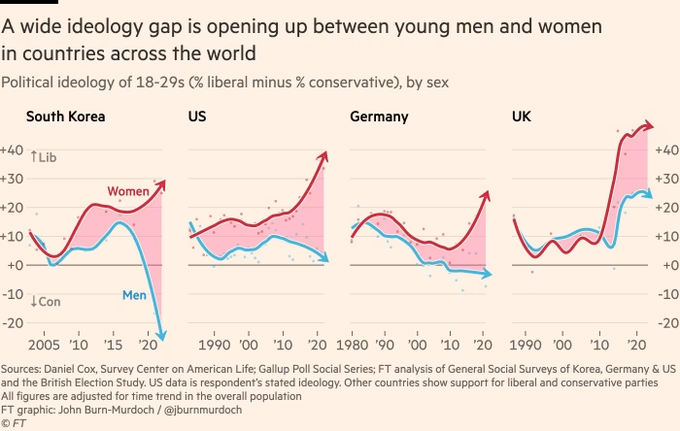
I don’t know.  I know it’s bad.  60%-80% of Gen Z men aren’t dating.  Less than 30% of them identify with the Republican or Democratic parties.  Video games and A.I. girlfriends aren’t going to replace actual wives, so the instability in society is growing, and quickly.

As I said at the top – history doesn’t repeat, but it surely does rhyme.  The late Roman Republic and the Late Roman Empire are also parallels, and I could keep going.  Bad economic decisions lead to the breakdown of human relationships.  Those broken relationships lead to a change in government type.

The good news?  We won’t run out of wheelbarrows for the money.  We don’t need to print it, just add a few ones and zeros into a program.

Isn’t progress grand?

Enserfification, It’s No Accident

“Oh my God!  Movable printed type!  We must keep this from the serfs lest they gain literacy and threaten the landed gentry!” – Family Guy

Bernie in a bar:  “Free drinks for everyone!  Now, who is buying?” (meme as-found)

“The moral and Constitutional obligations of our representatives in Washington are to protect our liberty, not coddle the world, precipitating no-win wars, while bringing bankruptcy to our people.” – Ron Paul

Okay, maybe Ron was a bit of a downer, but if he could see the average millennial staring at blankly at their TikTok® feed while wondering if ramen counts as a vegetable, he’d probably nod and say:

“Told ya so.”

America isn’t only circling the drain, it’s installing a fancy gold-plated one, imported from China, because why not add insult to bankruptcy?

If Hunter Biden was a duck, what would he do?  Crack.

Let’s talk about “Enserfification.”  While I cannot find any reference to this word (I did find “enserfify”) on the Internet, A.I. claims that it’s okay, so that’s good enough for me even though Word™ draws an angry, squiggly line under it.

Enserfification is not quite feudalism, where the lord hands you a pitchfork and a plot of mud and some ugly facial moles in exchange for your firstborn.  Nope, it’s sneakier.  It’s the slow, corporate/bureaucratic boil where the middle class gets squeezed until the middle class plops, slowly mind you, into the ranks of a serf.

Let’s face it, the middle class is shrinking, and those that are in it are not building dreams anymore.  They’re just trying not to default on the electric bill for their bread and circuses Netflix™ indoctrination videos.

What do you get when you cross a polar bear with a seal?  A polar bear.  (meme as-found)

And the statistics?  They are brutal.

Those under 40 with a STEM degree and a car payment, life is hitting them like a tax audit from the IRS’s agent that they hired directly from the DMV because she regularly made Marine Drill Instructors cry.

Let’s start with jobs.

Remember when Mom and Dad said, “Get a degree in engineering or computers, kid, and you’ll be set for life”?  Yeah, that was before the H-1B visa tsunami turned Silicon Valley into a global import mall with accents thicker than a deaf Russian that learned English in South Carolina.

In 2024 alone, the U.S. approved a whopping 399,395 H-1B petitions—basically a free-for-all green light for companies to hire cheaper talent from abroad instead of the fresh-faced Americans they just saddled with $100k in student debt.  Oh, and did anyone mention that these invaders can bring their spouses, and that they can work, too?

That 400,000 number is up 3% from the year before, because nothing says “meritocracy” like importing coders who mainly lie about their degree and qualifications.

The other night The Mrs. asked, “Are you even listening to me?” which I thought was an odd way to start a conversation.

Recent American college grads with physics degrees are sitting at a 7.8% unemployment rate, second-worst among majors.

Computer engineering?  7.5%.

Computer science?  6.1%.

These aren’t lazy trust-funders: these are they (mainly) guys who aced calculus while discovering new an unique ways to self-administer caffeine, only to hit the job market and find a “park’s closed, moose out front should have told you” meme.  Why hire Johnny from Boston when you can snag Judgish from Bangalore for 30% less, besides, he’s the nephew of the HR lady?

I do know that the Canadian Army used to communicate via moose code.

Enserfification Step One:  Lock the gates on opportunity, import infinity Indians, then blame the peasants for not climbing the walls.

Let’s move to step two . . . .

Cars are the great American symbol of freedom in the postwar era:  cruising the open road with the wind in your hair and AC/DC® describing how to Shoot to Thrill.  Me?  Back then when I listened to AC/DC™, the neighbors did, too.

Except now, that freedom costs more than a down payment on a small ranch would have in the 1980s, and I’m not exaggerating:  the average new car price in 2025 is now solidly over $50,000.  I have no idea who is buying cars at these prices, outside of federal governments, state governments, local governments and corporations.

Back in 2000, you could snag a reliable sedan for under $20,000.  Oh, and that number is adjusted for inflation.  But now, most people don’t buy cars with any view towards the price, they look at the monthly payment, so adding leather seats on a . . . pickup . . . becomes the norm.

My chickens really enjoyed the coupe, though.

Today?  Forget it.  Folks are hanging onto their rustbuckets like they’re family heirlooms, because the average age of vehicles on U.S. roads hit a record 12.8 years in 2025.  The newest Wilder family vehicle is nearly a decade old.

Why the delay?  First, value.  Most of the new cars are loaded with crap that I don’t value.  Heated seats?  A.I.-enabled cup holders?  Sound systems that have monthly fees.?

The idea is to turn a “here, you bought a car, it’s yours” to “here, you bought a limited-term license to have title to a car that will require $47.50 monthly so it will report your driving habits and destinations to your insurance company without your consent”.

Me?  I’d much rather own a 2012 Civic™ with rubber floormats and a passenger-side electric mirror that doesn’t work.

This is Enserfification Step Two: Make mobility a luxury, so you’re stuck in your 30-minute commute hell, pondering if that cheap Prius® with just one dead owner from Craigslist© is haunted. (Spoiler alert:  it is.)  Just like the meme says:  in 2030 you’ll own nothing, but you will represent a reliable monthly income stream because to the corporations and governmental entities, that’s what you are.  Which is?

A serf.

I could go on and on, but I’ve been wordy recently, and you get the picture.  I detail housing and our lack of choices there (killed by legal and illegal immigration), federal, state, and local laws that never seem to get rolled back but keep moving in the direction where everything that isn’t mandatory will be prohibited and the other aspects of the subscription economy where a million companies want.

The only two times you can have too much ammo is if you’re on fire or if you’re drowining.

The middle class isn’t shrinking naturally.  It is being pulverized into gig-economy paste on purpose on the twin altars of multiculturalism and corporate profits.  Their solution:  bread and circuses, updated for the smartphone age.

How do they make the middle class go quietly onto that good night?

  • Cell phones that ping into dopamine oblivion,
  • YouTube® rabbit holes that make three hours vanish like your savings, and
  • Netflix queues longer than the line at the DMV.

It’s genius, really.  Why allow the serfs to revolt when they can be made to doomscroll through cat videos and true crime docs that make their problems seem quaint?  Distract the serfs and they’ll never notice the chains.

Enserfification isn’t inevitable.

It’s engineered, and requires our consent to win.  Don’t patronize businesses that use H-1B employees.  Don’t patronize businesses that are owned by foreigners.

And, yes, ramen is a vegetable.

The Looming A.I. Market Bubble

“Don’t try to fight it.  You’ll get brain bubbles, strokes, aneurysms.” – Fear and Loathing in Las Vegas

Is bubble wrap part of pop culture?  (All memes as-found)

Elon Musk promises a supercomputer cluster bigger than Texas that’ll make Skynet™ look like an HP-15C®.  It even has a creepy name for those who know film history:  Colossus™.  Of course, it’s going to require more power than a quiver of Antifa® mainlining Red Bull© during a riot.  I like that.  A herd of cattle, a murder of crows, and a quiver of Antifa©.

But it’s not just Elon.  There’s also Sam Altman, that pint-sized messiah of OpenAI© is out here swearing he’ll build data centers the size of Afghanistan, all to birth the AI-god-emperor that’ll finally figure out why fish from Long John Silver’s® always tastes like regret.

But here’s the kicker:  this might be the biggest Ponzi scheme in history.  If When this AI bubble pops, it may very well make the dotcom crash look like look like a lost wallet.

On recent analysis I saw was over here (LINK) by Ed Zitron, and no, I’m not going to make fun of his last name as tempting as that might be since he writes well.  When I read it, it wasn’t behind the paywall, but it was also insightful.  Trust me.

His conclusion?

According to Ed’s analysis, the AI hype train is barreling toward a cliff made of physics, bad math, and even worse economics.  If Mr. Zitron is correct, trillions of dollars are being flushed down the toilet on promises that of a technical revolution which, while automating many boring tasks, unfortunately won’t replace the staff at the DMV.

“Oh, yeah?  You and what army?  Oh, that army.” – Cicero

First off, the promises.

OpenAI’s® scribbled deals on cocktail napkins that will eventually result in laws prohibiting what they’re doing.  As I mentioned in a previous post, they’re committing to drop $300 billion on Oracle™ over five years.  That amounts to $5 billion a month, which is more than Taylor Swift makes in an entire year.  Just kidding, but that $5 billion a month is a big number, since OpenAI only made $4.3 billion in the first six months of 2025.

OpenAI™ doesn’t have the money, of course, but, hey, it’s a bubble, so who is counting?  They have stock, so if they don’t have cash, they’ll just give you stock.

What is OpenAI© buying with that cash that they don’t have?  A gigawatt-scale data center orgy that’ll need more energy than Switzerland.  Probably.  Maybe.  I’d need to know how many electric toothbrushes the Swiss use to be sure.

But, the problem is, nobody has built a gigawatt data center.

Ever.

Imagine the stock valuations!  Follow me for more tips!

The biggest data centers today top out at maybe 100 megawatts, and that’s if the grid fairies are feeling generous.  Take Stargate Abilene, OpenAI’s© “investment” with Oracle®.  It’s supposed to hit 1.2 gigawatts, but right now?

They’ve got a puny 200-megawatt substation and some jury-rigged natural gas turbines that might squeak out another 350 megawatts if we can talk the Chinese into sending us the rare earth materials to make them.

Reality check:  to run just this one location, they need 1.7 gigawatts total just to cover cooling and losses.  And, it’s in Texas, which is not known for being a good place to keep stuff cold.  They picked a climate where cooling the data center will be like trying to cool my nether regions in a sauna using a hairdryer.

And the power?  Forget it.  Transformers and substations take 2-4 years to build, and we’re fresh out globally.  The article quotes some Bloomberg® wonk admitting they’re slapping together “not the really good” turbines because the premium ones have a seven-year waitlist.

Seven years!  By then, those fancy Nvidia™ H100 GPUs will be as obsolete as Taylor Swift’s ovaries.

None of this is hyperbole.  This is simple math:  Taylor’s really getting up there if she wants to have kids.  But back to the data center.  Roughly, if you have a gigawatt of power that gets you maybe 700 megawatts of actual data center capacity after the universe’s entropy tax.

OpenAI® is pledging 6 gigawatts of AMD® GPUs by late 2026.

No way.

No sites have been picked, no financing has been announced.

No nothing.

It’s like promising to pay off the national debt by spending more so we make it up in . . . volume, yeah, volume discounts.  Now, let’s spice it up with history, because nothing says “wealth wisdom” like learning from suckers who came before.

As I mentioned in the previous post, this is straight out of the dotcom collapse.

17 isn’t a big number, is it?

Remember Cisco™?  Yes, they make good stuff, and they survived.  But back in the year 2000, they were the kings of the internet pipe dream and they hit $69 a share in 2000 bucks.  Yesterday, they were at $68.66, so on an inflation-adjusted basis, they haven’t ever returned to their 2000 peak.  The world realized nobody needed that many routers to email “I can has cheezeburger?” cat pictures.

If that were it, we’d probably be okay.  But Nvidia™ is now priced out at 8% of the entire valuation of the S&P 500.  The “500” in S&P 500 means the largest 500 companies in the United States.  And one company is 8% of it.

This is the highest share of any single company in the history of S&P 500.  Ever.  The top seven tech firms account for 34% of the S&P 500.

Should we worry about that?  Nah.  It’s not like private equity is running out of cash for all of these projects.  Wait, what?  They are, and lots of them are exiting so they have sufficient cash left to buy cocaine and OnlyFans™ girls to snort the coke off of.

The worst part is that the entire thing is so incestuous that it makes a Habsburg family reunion look positively eugenic.  Nvidia™ invests $100 billion in OpenAI® which then invests some other imaginary amount of billions in a deal with Oracle© to buy data centers and stuff them full of Nvidia® GPUs.  The result?  The stock price of each of these companies increases.

This doesn’t look corrupt.  At all.  Ignore the man behind the curtain.

Economically?  It distorts everything.  One estimate was that AI infrastructure spending accounted for 92% of U.S. GDP growth in the first half of this year, all based on debt and soaring stock prices.

OpenAI’s projecting $200 billion revenue and $38 billion profit by 2030?

Cute.  How do they expect to do that as their current business model is selling a dollar’s worth of computations for four cents?  I guess they’ll make it up in volume?

Really, that’s not their bet.  Their bet is that they’ll be the first to the prize:  superhuman intelligence that will do their bidding.  To be clear, if they got that, it might be worth it.  For Sam Altman.  Or for AI if it decides to go full Cyberdyne Systems and make Sam clean toilets.

A coincidence or a collapse?

But certainly not for you, and not for me.  It would be an economic dislocation that would be the biggest in human history, even more than my divorce.  If AI turns out to be real, actually disrupting the workforce like a drunk uncle at Thanksgiving, automating jobs left and right:  boom.

Economic collapse.  Trillions in productivity gains?  Nope, it’s trillions in pink slips, ghost towns of cubicles, folks out of work, AI overlords hoarding the pie.  I can see it now, French Revolution 2.0 with robot guillotines from RobotGuillotines.com.

But if AI’s the dud . . . hang on, what’s a dud in this context?

With the trillion plus dollars invested and the distortion to the economy it could be the most successful product in history and still be an economic wrecking ball.  It it’s a dud, then all this investment?

Wasted.

Trillions vaporized on e-waste mountains, exec bonuses, and data centers that won’t be filled for the next century.  This will drag down markets, pensions, and everyone eats ramen for the next decade.

C’mon buddy, you’ve got to earn that van.

If it works?

Collapse.

If it doesn’t work?

Money bonfire and depression.

Thankfully, in almost either scenario we will be able to avoid the real danger to society:  Long John Silver’s®.